Portland cements and blended cements (which incorporate pozzolan and/or mineral admixtures to normally manufactured Portland cements) are hydraulic since they set and harden to form a stone-like mass by reacting with water. The term hydraulic cement is an all inclusive term that includes both Portland cement and blended cement. Cement is the bonding agent used in a concrete mix.
There are five types of Portland cement (I, II, III, IV, V), each manufactured to meet different needs and therefore having somewhat different physical and chemical characteristics.
Type I is a normal, general-purpose cement. It is suitable for all uses when the special properties of the other cement types are not required.
Type II cement generates less heat, at a slower rate, and has a moderate resistance to sulfate attack. It can also be used in structures of considerable mass, such as large piers, heavy abutments, and heavy retaining walls to control temperature rise within the concrete and/or in warm or hot weather concreting. Type II is also used when sulfate concentrations in ground waters are higher than normal.
Type III is a high-early-strength-cement. It develops higher strength at an earlier age. It is used when early form removal is desired. Alternatively, richer mixtures (with higher cement content) of Types I and II may be used to gain early strength.
Type IV cement has a low heat of hydration and develops strength at a slower rate than other cement types. It is used in massive concrete structures, such as dams. This type of cement is for use where there is a little chance for the heat to escape from the concrete mass, and when temperature control is critical.
Type V cement is used in concrete exposed to a severe sulfate exposure. It is used mainly where concrete is exposed to severe sulfate action such as concrete structures exposed to soil and groundwater with high sulfate content.
1. Fineness
The fineness of cement affects the rate of hydration. As cement fineness increases, the surface area of the cement particles increases. Therefore, the rate of reaction increases, and the strength development is accelerated.
2. Setting Time
A cement paste must remain plastic long enough to permit normal placing and finishing. The length of time that a concrete mixture remains plastic depends more on the temperature and water content of the paste than on the setting time of the cement.
3. False Set
False set is evidenced by a significant loss of plasticity shortly after the concrete is mixed. Further mixing without the addition of water can restore plasticity. There are several factors that promote false set; the most common is heating of the cement during grinding operations.
4. Heat of Hydration
Heat of hydration is the heat generated when cement and water react. The amount of heat generated is dependent chiefly upon the chemical composition of the cement. The rate of heat generation is affected by the fineness of the cement, the temperature of curing, and the chemical composition of the cement.
5. Quick Set or Flash Set
Quick Set or Flash Set usually occurs when Portland cement is insufficiently retarded; the time of initial setting is considerably less than one hour at normal temperatures. Quick set may be due to insufficient or faulty gypsum in the Portland cement, or to improper chemical composition of the clinker. The chemical reactions involved liberate a large amount of heat and the set cannot be overcome by remixing the paste.
6. Specific Gravity
Specific gravity is the ratio resulting from dividing the solid weight of a material to the weight of an equal volume of water at standard conditions of temperature and pressure. The specific gravity of Portland cement is generally about 3.15.
The chemical process by which cement reacts with water is called “hydration”. As the reactions proceed, heat is liberated (exothermic reaction) and the products of the hydration process gradually bond the concrete components. It is possible to get an indication of the rate at which cement minerals and water are reacting by monitoring the fluidity and the rate at which heat is generated in the concrete mixture.
SETTING TIMEDuring the hydration process the concrete paste gradually loses its plasticity, shows signs of stiffness, and then becomes a stiff mass but without any sizeable strength. The time and degrees of relative stiffness can be measured by a standard test method which allows the determination of both the initial set and final set of a given concrete mixture.
Initial setting defines the point in time when the concrete is no longer fluid and shows the first signs of stiffening. Initial set takes place approximately 2 to 4 hours after the cement has come into contact with the water.
Final setting defines the point in time when the concrete has completely lost its fluidity and shows the consistency of a stiff mass but without any appreciable strength. Final set in a typical concrete mixture takes place approximately 5 to 8 hours after the cement and water were placed in contact.
One should recognize that the “setting” process is associated with fluidity of the concrete mass, and is not necessarily accompanied by a drying process; it takes place even if the fresh cement paste is kept under water. The strength development process, also known as “hardening”, is associated with strength gain and takes place after the concrete reaches final setting.
“Hydration”, “setting” and “hardening” processes are the result of a series of simultaneous and consecutive chemical reactions between water and the constituents of portland cement.
FLY ASH (POZZOLAN)
Fly ash is a byproduct of the burning of coal in power plants. It is removed by mechanical collectors or electrostatic precipitators as a fine particulate residue from the combustion gases before they are discharged to the atmosphere.
Only a few power plants produce an “ideal” fly ash (with a combination of high fineness and low carbon content). Some plants produce a coarse fly ash, with low carbon content and low fineness. This type of fly ash can be satisfactory used in concrete provided that laboratory tests confirm its beneficial performance.
Fly ash particles are generally finer than cement particles. A fly ash having finer particles is generally preferred for use in concrete, as it will generally promote higher strength. The specific gravity of fly ash generally ranges between 1.88 and 2.84, with the finer particles having higher specific gravities.
TYPES OF POZZOLANIC MATERIALS
Class N: Raw or calcined natural pozzolans
1. Clays and shales: montmorillonite, kaolinite, and illite types.
2. Opaline materials: opaline cherts and shales, and diatomaceous earths.
3. Volcanic tuffs and pumicites: rhyolitic, andesitic, phonolitic and basaltic types.
Class F: Fly ash normally produced from burning anthracite or bituminous coal that meets the applicable requirements for this class as given in ASTM C 618. This fly ash has pozzolanic properties.
Class C: Fly ash normally produced from lignite or sub-bituminous coal that meets the applicable requirements for this class as given in ASTM C 618. This class of fly ash has some cementitious properties. Some Class C fly ashes may contain lime contents higher than 10%.
Class S: Any pozzolan that meets the applicable requirements for this class as given in ASTM C 618. Examples of materials in this class include certain processed pumicites, and certain calcined and ground shales, clays, and diatomites.
Potential Benefits of Using Fly Ash and other Pozzolans in Concrete
Cement is the most expensive component of a concrete mixture. The introduction of a pozzolan in a concrete mixture can improve the fresh and hardened properties of a concrete mixture while reducing its costs. Some of the effects of using a pozzolan in a concrete mixture are listed below:
In Fresh Concrete:
1. Reduced water requirements of the mixture, especially when the pozzolan is fly ash.
2. Increased workability, reduced bleeding and segregation.
In Hardened Concrete:
1. Modification of the mixture’s strength development characteristics by postponing strength gain; this can increase plastic flow at early ages and reduce cracking.
2. Reduced drying shrinkage.
3. Improved water tightness of the concrete.
4. Improved resistance to sulfate active soils and waters with high sulfate content.
5. Inhibited and/or reduced alkali-aggregate reaction.
6. Reduce adiabatic heat of hydration of massive members.
Potential Deleterious Effects of Using High Carbon Fly Ash in Concrete
Unburned, residual, carbon in fly ash can have a dual detrimental effect in concrete. First, unburned carbon particles will tend to float to the surface due to their low density and can cause discoloration problems in the concrete. Second, unburned carbon particles can affect both the amount and stability of air entrained agents (AEA) used in concrete, thus affecting the cost and the freeze and thaw durability of the concrete. Consistently low carbon content is extremely desirable in a fly ash to maintain and control the air content in a concrete mixture.
MIXING WATER Almost any natural water that is drinkable is satisfactory as mixing water for making or curing concrete. However, water suitable for making concrete may not be necessarily fit for drinking. Water is added during batching of the concrete volumetrically or by weight. To add all the components in concrete in like units, it may be necessary to convert gallons of water to pounds of water. The conversion factor used is 1 gallon of water weighs 8.33 pounds. For example:
32.0 gallons of water x 8.33 = 267 pounds of water
AGGREGATES
Aggregates must conform to certain requirements and should consist of clean, hard, strong, and durable particles; free of chemicals, coatings of clay, or other fine materials that may affect the hydration and bond of the cement paste. Aggregates characteristics influence the properties of concrete.
Weak, friable or laminated aggregate particles are undesirable. A well graded aggregate with a low void content is desired for efficient use of paste. Aggregates containing natural shale or shaly particles, soft and porous particles, and certain types of chert should be especially avoided since they have poor resistance to weathering. In a properly made concrete mix the concrete should consist of particles having adequate strength and suitable weather resistance.
Characteristics of Aggregates
1. Resistance to Freezing and Thawing - (Important in structures subjected to weathering): The freeze-thaw resistance of an aggregate is related to its porosity, absorption, and pore structure. NCDOT Specifications require that resistance to weathering be demonstrated by the sodium sulfate test.
2. Abrasion Resistance - (Important in pavements, loading platforms, floors, etc.): Abrasion resistance is the ability to withstand loads without excessive wear or deterioration of the aggregate. NCDOT Specifications require that abrasion resistance be demonstrated by the Los Angeles Abrasion Test.
3. Chemical Stability - (Important to strength and durability of all types of structures.): Aggregates must not be reactive with cement alkalies. This reaction may cause abnormal expansion and map-cracking of concrete.
4. Particle Shape and Surface Texture - (Important to the workability of fresh concrete): Rough textures or flat and elongated particles, require more water to produce workable concrete than do rounded or cubical aggregates.
5. Grading - (Important to the workability of fresh concrete): Grading or particle size distribution of an aggregate is determined by a sieve analysis. Grading (size distribution) and particle size can affect important properties of concrete such as cementitious requirements and ability to entrain air.
6. Specific Gravity - The specific gravity of an aggregate is the ratio of its solid weight to the weight of an equal volume of water at a given temperature and pressure. Most normal weight aggregates have specific gravity in the range of 2.4 to 2.9. It is not a measure of aggregate quality. It is used to calculate mixture proportions.
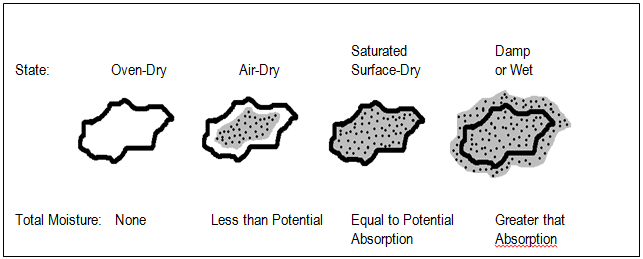
7. Absorption and moisture - Batch weights of materials must be adjusted for moisture conditions of the aggregates The moisture conditions of an aggregate are shown below. They are designated as:
a)
Oven Dry: completely dry, thus fully absorbent
b)
Air-Dry: dry at the surface but containing some interior moisture, thus somewhat absorbent.
c)
Saturated Surface-Dry (SSD): neither absorbing water from, nor contributing water to, the concrete mixture.
d)
Wet with Free Moisture: containing an excess of moisture on the surface.
8. Dry-rodded Unit Weight: Is the weight of one cubic foot of dry coarse aggregate that is compacted by rodding in a standard container in three equal layers. For any aggregate, the dry rodded unit weight varies with the particle size and gradation.
ADMIXTURES
Admixtures include all materials other than cement, water and aggregates that are added to concrete. Admixtures can be broadly classified as follows:
1. Air-entraining
2. Retarding
3. Water-reducing
4. Accelerating (only used in special circumstances)
5. Pozzolans
6. Workability agents
7. Miscellaneous, such as permeability-reducing agent, gas forming agents, and grouting agents
8. Water-reducing and retarding
9. Water-reducing and accelerating (only used in special circumstances)
10. Superplasticizers
Concrete should be workable, finishable, strong, durable, watertight, and wear-resistant. These qualities can often be obtained without the use of chemical admixtures (except for air-entraining admixtures) by using suitable materials and properly proportioning the mixture. There may be instances when special properties may be desired such as extended time of set, acceleration of strength, or a reduction in shrinkage. These types of concrete characteristics can be obtained by the use of admixtures. However, admixtures in general (any type or quantity) should not be considered as a substitute for good concrete practices.
AIR-ENTRAINING ADMIXTURES Concrete that is not air-entrained contains mostly entrapped air. Concrete that is air-entrained contains both entrained air as well as reduced amounts of entrapped air (depending on various factors including the degree and quality of consolidation). Entrained air is characterized by microscopic air bubbles that are well distributed, but not interconnected, throughout the cement paste. These bubbles are small and invisible to the naked eye. Entrapped air is composed of visible air voids that occur randomly in all concrete mixtures. The amount of entrapped air is largely a function of aggregate characteristics and degree of consolidation.
A concrete mixture can experience variations on its air content. These variations are the result of different factors such as aggregate proportions, gradation, mixing time, temperature, and slump. Adequate control is required to ensure the proper air content at all times. Since the amount of air-entraining agent per batch is relatively small (i.e., 3 to 8 oz. per cubic yard of concrete), it is important to first disperse the agent in the mixing water prior to mixing, and then proceed with the mixing process. This is important to achieve proper spacing, size and uniform distribution of the air voids within the concrete to achieve adequate freeze and thaw protection of the concrete.
Effects of Entrained Air on Concrete
1. Durability (Freeze Thaw Resistance): Is improved as air voids act as reservoirs which relieve the pressure of expanding water as it freezes. This prevents damage to the concrete. Air entraining agent is added to concrete primarily for increased Freeze Thaw Resistance, or Durability.
2. Workability: Is improved. Sand and water contents can be reduced. The plastic mass is more cohesive and looks and feels “fatty” or “workable”. As water is reduced, segregation and bleeding of the mixture can also be reduced.
3. Resistance to Deicing: Surface scaling is reduced.
4. Sulfate Resistance: Is improved.
5. Strength: Is reduced (if the only change is increased air). Strength depends upon the voids/cement ratio. “Voids” is defined as the total volume of water plus air (entrained and entrapped). If all things remain equal, and the only affected factor is an increase in the amount of air voids, then the concrete strength will decrease. However, strength reduction can be minimized because the improved workability allows for a lower water-cement ratio.
6. Abrasion Resistance: About the same as non-air-entrained concrete of the same compressive strength.
FACTORS AFFECTING AIR CONTENT
1. Coarse Aggregate Gradation: For given cement content there is little change in air content when the maximum nominal size of the aggregate is increased above 1-1/4 inch. For aggregate sizes smaller than ¼ inch, the air content increases sharply as the size decreases because of the increase in mortar volume.
2. Fine Aggregate Content: An increase in the amount of fine aggregate causes an increase in air content with a given amount of air-entraining agent.
3. Cement Content: As the cement increases, the air content decreases.
4. Slump: The air content increases as the slump increases up to about 7 inches, and decreases with further increases in slump.
5. Vibration: Prolonged vibration should be avoided. Regardless of the slump, 15 seconds of vibration causes a considerable reduction in air content. If vibration is properly applied, little of the intentionally entrained air is lost. Air lost during handling and vibration consists mostly of entrapped air, which large bubbles are undesirable for strength and finishability.
6. Temperature: Less air is entrained as the temperature of the concrete increases.
7. Mixing Action: The amount of entrained air varies with the type and condition of the mixer, the mixing rate, and amount of concrete being mixed. Figure 5 shows the effect of mixing speed and mixing time in a transit mixer. Figure 6 shows the effect on air content as agitating time is increased.
The amount of air specified in air-entrained concrete depends on the type of structure and the extent of exposure to deicing chemicals, freeze-thaw cycles, and chemically reacting soils or waters.
RETARDING ADMIXTURES
A retarding admixture is a material that is used for the purpose of delaying the setting time of concrete. Retarders are used in concrete to:
1. Offset the accelerating effect of hot weather on the setting of concrete.
2. Provide time for placing, or finishing, critical members such as bridge decks or large piers.
All retarders, listed on the NCDOT approved list, also function as water reducers. These are frequently called “water-reducing retarders.” Some retarders also entrain some air in concrete. A retarded concrete may lose slump faster than a non-retarded concrete. Because some retarding admixtures react with certain air-entraining admixtures, they are introduced into the mixing water separately.
Water-reducing Admixtures
A water-reducing admixture is a material used for the purpose of reducing the quantity of mixing water required to produce a concrete mixture of a given consistency. These materials increase the slump of concrete for given water content. A water reduction of about 5% is possible for a given slump.
Many water-reducing admixtures may also retard the setting time of concrete. Some water-reducing admixtures can also entrain air into the concrete. An increase in strength can generally be obtained with water-reducing admixtures if the water content is reduced and if the cement content and slump are kept the same. A rapid loss in slump, and a significant increase in drying shrinkage, can result from the use of some of these admixtures. Therefore, trail batch tests should be made with job materials.
Accelerating Admixtures
An accelerating admixture is used to accelerate the setting time and the strength development of concrete. The rate of strength gain in concrete can also be accelerated by:
1. Using Type III Cement
2. Lowering the water-cement ratio, or increasing the cement content
3. Cure concrete at higher temperatures
Most of the commonly used accelerators cause an increase in the drying shrinkage of concrete. Calcium chloride is the most commonly used accelerating admixture. Calcium chloride and other materials used as accelerators are not antifreeze agents. When used in normal amounts, accelerators can slightly reduce the freezing point of concrete by only a few degrees.
Many commercial accelerating admixtures contain calcium chloride and are not recommended for use in items such as:
1. Prestressed concrete
2. Concrete with embedded aluminum conduit
3. Concrete with galvanized steel reinforcement
4. Concrete subject to alkali-aggregate reaction
North Carolina Specifications do not allow the use of an accelerator except when approved by the Engineer.
High Range Water Reducing Admixtures (Superplasticizers)
A superplasticizer is a high range water reducing admixture. These materials reduce water in the 12 to 20% range. Dosage rates are typically specified in ounces of admixture per 100 lbs. of cement used in the concrete mixture. The dosage rate is usually recommended by the manufacturer.
Effects of using a superplasticizer
1. Recommended for concrete to the pumped or tremied.
2. Allows lower water-cement ratios, which will result in higher strengths.
3. Increased flow-ability for a placement where vibration cannot be achieved.
4. Labor could be reduced.
5. Shrinkage cracking may be reduced due to lower water content.
6. Recommended for precast work, such as prestress concrete, where early strengths are required to release concrete beds for production purposes.
Many superplasticizers lose workability within 30 to 60 minutes depending on conditions and dosage rates. Some may entrain air and retard the setting time. If slump becomes too high, it is possible to have segregation; drying shrinkage may also become a problem. Trial batches should be checked with job materials before using superplasticizers.