Sampson County Bridge No. 810003 is a three-span prestressed channel structure built in 1966 on Service Route No. 1933 across Branch Six Run Creek. Six channel beams (12 stems) were retrofit in November of 2020 using a prestressed mechanically fastened fiber reinforced polymer (MF-FRP) system. The retrofit was designed to restore prestressing forces lost due to corrosion of internal steel strands. The retrofit was intended as a temporary measure to keep the bridge open without lowered load postings while a bridge replacement could be designed, bid, and scheduled. Bridge 810003 is scheduled for demolition and replacement in late 2022 or early 2023.
The proposed research aims to salvage the six retrofitted channel beams from Bridge 810003 that have been in-service for more than 21 months. In addition, the work proposes to salvage two additional control beams from the bridge that have not been retrofitted. Beams will be identified prior to bridge demolition, removed from the bridge during demolition with the MF-FRP repair systems intact, trucked to Constructed Facilities Laboratory (CFL) in Raleigh, and tested to failure in the laboratory.
Samples of the FRP material will be recovered from the tested beams and for material-scale tension testing. Concrete cores will be taken from the beams to determine the concrete compressive strength.
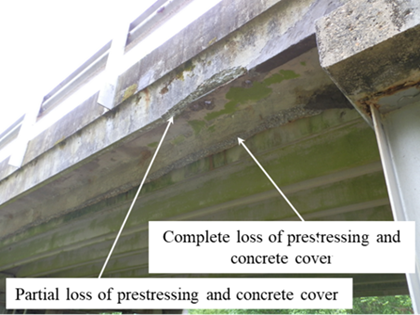
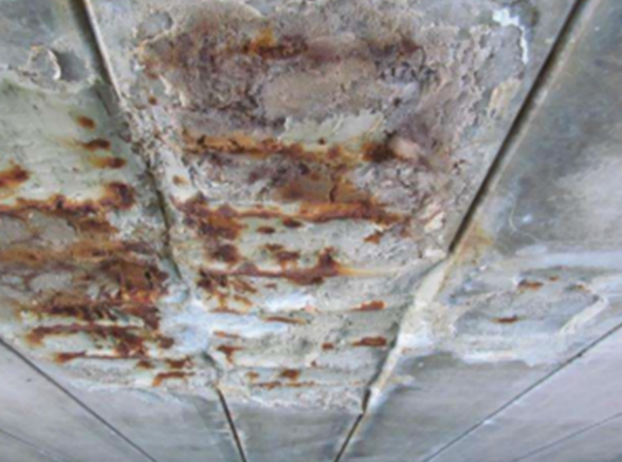
Examples of repairable deterioration of PC bridge
beams
The proposed experiments will capture the full response to failure of the retrofit beams, allowing for comparison to analytical predictions and evaluation of the effectiveness and durability of the retrofit.
Predications of beam behavior will use the procedures developed as part of previous research project RP2018-16. As justified by the research results, edits to the existing design methods, installation procedures, inspection procedures, ratings spreadsheet, and standard details and specifications will be developed and proposed.
This proposed research project presents a unique opportunity to evaluated the performance of in-service girders that cannot be replicated on new concrete girders.