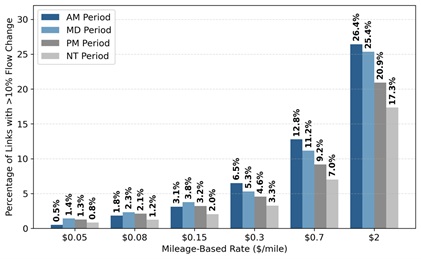
Declining motor fuel tax revenues driven by increasing fuel efficiency and zero-emission vehicle adoption have prompted North Carolina to evaluate Mileage-Based User Fees (MBUF) as a sustainable funding alternative. This study combines literature review, survey-based behavioral modeling, and statewide network analysis to assess the feasibility and potential impacts of MBUF. A comprehensive review of prior work revealed MBUF's promise as a stable, flexible revenue source, alongside persistent challenges of public acceptance, privacy, and implementation. To extend this evidence, the research team conducted the Survey to Understand the Impact of MBUF on Travelers' Choices (SUMTC) in April 2024, collecting 1,113 responses (881 valid). The survey combined revealed preference questions with stated preference experiments across seven modes using a D-efficient design. Descriptive analysis showed that cost, time, and convenience were the strongest determinants of travel, with most respondents expressing limited concern about whether charges were fuel-based or mileage-based as long as trip costs remained modest. Joint RP–SP discrete choice models revealed that higher MBUF rates reduce the likelihood of driving alone, carpooling, or using park-and-ride, with sensitivities varying by age, employment, and trip purpose. Route choice models using CatBoost achieved 87% accuracy, with toll road use frequency, age, and departure time as key predictors. A synthetic population framework fused Public Use Microdata Sample and National Household Travel Survey data to extend these insights statewide, while TransCAD simulations tested MBUF as link-level tolls. Results showed only modest increases in total system travel time, even at unrealistically high rates. Findings suggest that MBUF, implemented revenue-neutrally, is unlikely to significantly alter travel behavior. Transparency in communicating total trip costs emerges as the foremost priority for successful implementation.