Traffic
crashes and associated delays are a major concern in rural freeway work zones,
particularly when lane closures result in queueing that can surprise motorists.
The present study explored the safety and operational benefits of using dynamic
zipper merge (DZM) systems to encourage orderly merging at 2:1 lane closures
when traffic is heavy (the systems were configured to revert to conventional
merging when traffic was light). Safety data for ten DZM sites comprising
nearly 3600 days of construction were compared with six conventional merge (CM)
sites comprising 210 days of construction. A two-step process was used to
derive a crash modification factor (CMF) for the DZM treatment. First, the work
zone crash rates (measured in crashes per million vehicle-miles traveled) were
compared to baseline crash rates for each project site, resulting in
significantly different rate ratios (RRs) of 2.58 [95% C.I. 2.02, 3.13] for
conventional merge (CM) sites and 1.43 [0.93, 1.94] for DZM sites. Crashes
involving deer and other animals were excluded from these rate ratios. Second,
the two rate ratios were compared to compute the CMF for the DZM treatment
(compared to CM). The resulting CMF was 0.56 [0.43, 0.71], corresponding to a
crash reduction factor (CRF) of 44% [29%, 57%]. DZM systems appeared to be
effective at reducing crashes during congested hours and—based on limited
evidence—to decrease the proportion of rear-end crashes. Likewise, the findings
indicate that the strongest operational benefit of the DZM lies in improved
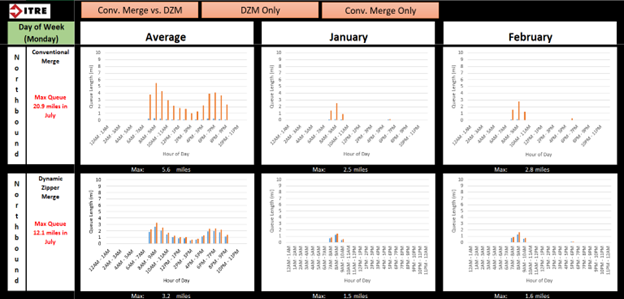
travel-time index (TTI), not in increasing or preserving average speeds. Across
all sites and time periods, DZM consistently limited the growth of TTI relative
to CM, suggesting better preservation of predictable and stable traffic
conditions during construction.