EXECUTIVE SUMMARY
To limit rutting in asphalt pavements, NCDOT requires that surface asphalt mixtures meet the Asphalt Pavement Analyzer (APA) test criteria. Mixtures with rut depths below the specified threshold under APA loading are accepted. However, the APA test has several limitations: (1) it requires six hours of temperature conditioning and over two hours of testing, making its long turnaround time suitable only for mix design and acceptance; (2) the device is expensive, heavy, and requires significant laboratory space, limiting accessibility for contractors; and (3) state highway agencies (SHAs) have reported high variability in test results and insufficient correlation with field performance. To ensure pavement performance while reducing testing costs, it is imperative to identify a practical alternative method for evaluating the rutting resistance of asphalt mixtures in North Carolina.
The IDEAL-RT test has recently gained prominence due to its simplicity, rapid execution, and strong predictive capability. Multiple SHAs have adopted it for mix design, acceptance, and quality assurance. As a promising alternative to the APA, it is essential to evaluate the effectiveness of the IDEAL-RT test for North Carolina mixtures.
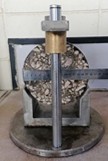
IDEAL-RT test fixture
Correspondingly, the objectives of the proposed research project are to: (1) evaluate the effectiveness of the IDEAL-RT test using NC mixtures, (2) determine the optimum testing condition of the IDEAL-RT test, (3) determine preliminary performance criteria for NC mixtures, and (4) draft testing specifications for its implementation in NC. These objectives will be accomplished by executing the following six tasks:
1. Literature Review: Conduct a comprehensive review to collect information on procedures, testing conditions, acceptance limits, and validation methods for rutting performance tests used by other SHAs. Identify NC mixtures with documented rutting performance.
2. Material Acquisition and Testing: Acquire twelve NC surface mixtures and perform APA, IDEAL-RT, and Stress Sweep Rutting (SSR) tests.
3. Evaluation of IDEAL-RT Effectiveness: Compare IDEAL-RT results with APA rut depths and RSI indices from the SSR test at the material level. At the structural level, compare rankings of mixtures from the IDEAL-RT with both field performance and predicted performance from FlexPAVE (using SSR results as inputs).
4. Testing Conditions and Thresholds: Recommend the appropriate air void level for IDEAL-RT samples and establish preliminary threshold limits based on findings from Task 3.
5. Specification Development: Develop a draft testing specification for IDEAL-RT within the framework of NCDOT standards. The specification will consider applications in both mix design and quality assurance (QA).
6. Final Report: Prepare a comprehensive final report summarizing all tasks, findings, and recommendations.
The research will produce an improved testing specification to ensure asphalt mixture quality and performance in both mix design and QA. Implementation of the specification will also reduce the cost and turnaround time of rutting susceptibility testing for asphalt mixtures in North Carolina.