EXECUTIVE SUMMARY
As a result of Hurricane Helene in late 2024, the spanning members of nearly three dozen temporary bridges in Western North Carolina (WNC) are (or were recently) comprised fully or partially of repurposed flatbed railroad cars. Many of these bridges will need to stay in operation for long durations before permanent replacements can be completed, necessitating a detailed study of these temporary structures, especially from the perspective of load rating. The bulk of published literature on railroad flatcar (RRFC) bridges is generally focused on permanent structures with composite concrete decks, which the temporary structures in WNC do not have.
Additionally, prior work on RRFC bridges with non-composite steel or timber decks and/or non-composite asphalt wearing surfaces is generally focused on RRFCs of a different geometry and/or span than the RRFCs currently in use in WNC. As such, proposed study of the WNC RRFCs is justified by a goal to develop load rating methods and tools for the current temporary applications (or similar applications in the future).
In addition, a secondary goal involves determining the rated load capacities of existing RRFCs in a variety of potential future use scenarios, as the Department plans to store RRFCs for future use once existing temporary structures are removed from service. A chart of load ratings for different types of flatcars in different conditions supported on different spans would be useful for future deployments.
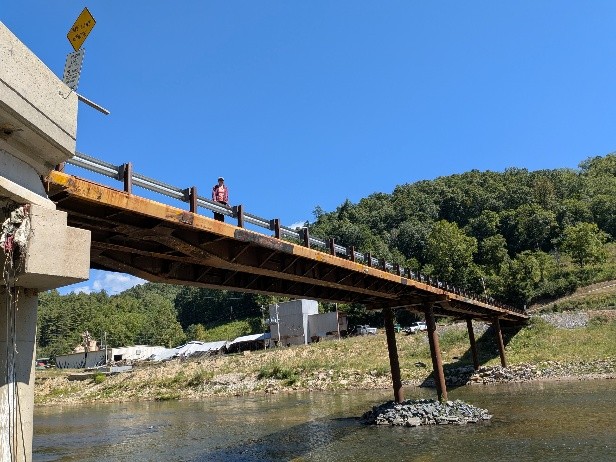
Temporary RRFC bridge near Burnsville
The proposed work will accomplish the goals by first measuring the geometry and documenting the condition of a wide range of existing RRFC bridges in WNC. An estimated 10-15 bridges will be measured using traditional methods. These measurements are necessary because railroad flatcar designs are not standardized – many manufacturers have existed over the years that have produced many specific flatcar designs for different railroad specifications. Thus, while the RRFCs in use in WNC appear to be of one general type (Type FM, F-class, 90' length), at least two variations are currently in temporary bridge service in the state.
With the likely range of geometry and structural condition of the WNC railcar fleet documented, finite element models will be developed in Abaqus to reflect idealized versions of this geometry for all significant flatcar variants in service. Rolling loads will be applied numerically to the models, enabling a detailed study of RRFC bridge performance under a variety of conditions. Parameters can then be varied in the models to study the effects of material properties, span lengths, damage levels, adjacent connected flatcars, and other relevant factors.
Critical to developing a finite element model (FEM) will be validating that model with experimental data prior to running the parametric analyses. Data from limited field testing will be available from recently completed preliminary work, but full-scale experimental tests are proposed as part of this research. Two full-scale railroad flatcars are proposed to be tested to failure in the structures laboratory at NC State University or at a North Carolina Department of Transportation storage yard. Data will be collected during each test to include loads, deflections, and strains, enabling validation and benchmarking of the FEM. Together, the experimental and analytical results will be used to create outputs useful for load rating temporary bridges, including proposed load rating methods and simplified design tools, such as capacity charts, specific to the types of cars in WNC and a variety of possible RRFC bridge configurations.