710-1 DESCRIPTION
This section of the Specifications expands on the general requirements of
Section 700 and gives the specific details and requirements for concrete pavement construction. While these Specifications will apply to most non-reinforced, jointed pavements with dowels, project personnel should always refer to the plans and Project Special Provisions for exceptions to the Standard Specifications.
710-2 MATERIALS
The specifications for concrete pavement materials are detailed in
Division 10 of the Standard Specifications.
710-3 COMPOSITION OF CONCRETE
Concrete pavement mixes are designed by the Contractor and submitted through the Engineer to the
Materials & Tests Unit for review and approval.
Article 1000-3 of the Standard Specifications details the various requirements for these mixes and the supporting data that the Contractor must supply.
The Strength-Maturity curve should also be submitted with the Concrete Mix Design and the other required information (See
700-13 in the Standard Specifications).
Prior to submitting a proposed mix to the Materials & Tests Unit, the Engineer should satisfy himself that all of the information required for evaluating the mix has been furnished. On most concrete paving projects, more than
one mix will be required due to the use of hand-placement methods, early strength requirements, or other factors. The Engineer should be thoroughly familiar with the requirements of the project and have readily available any information required relating to job mixes.
The Engineer and the Contractor should pay close attention to those quarries whose aggregates are known to exhibit ASR characteristics. These quarries are listed on the
Materials and Tests Unit’s website. When a concrete mix design contains aggregates from one of these listed quarries, the design should also include a pozzolan, such as fly ash, GGBFS, or Microsilica in the amounts listed in
Article 1024-1, to inhibit the potential ASR problems.
The adjustment of mix designs when necessitated by low compressive strength is a critical factor, and the Engineer should notify the State Construction Engineer and Contractor immediately upon failure of the initial test beams to meet Specification requirements. The failure of a series of test cylinders to meet Specification compressive strength requirements at any time during production may indicate faulty testing procedures or a change in materials, and immediate checks and tests to determine the source of the deficiency should be made.
710-4 ACCEPTANCE OF CONCRETE
Acceptance testing and sampling of the concrete mix is the responsibility of the Engineer. The Contractor is required to furnish the materials to be sampled and tested. The Specifications outline several areas where the Engineer will perform acceptance testing.
Assistance in determining the correct procedures and frequency of testing can be found by contacting the
Materials & Tests Unit. Also, refer to
Article 700-15 for more details on compressive and flexural strength sampling and testing requirements.
When the average of the Department’s compressive strength test results are below
4500 psi, the Engineer will perform an investigation.
710-5 CONSTRUCTION METHODS
Concrete pavement will be constructed in accordance with the provisions of
Section 700.
Concrete pavement should be placed in
2-lane minimum widths; however, there are a few exceptions noted. Refer to the plan details for joint locations and spacing, lane widths, etc., when large areas of concrete pavement are to be constructed, such as parking lots, in rest areas, weigh stations, etc.
710-6 FINISHING
The concrete in front of finisher float machine screeds should be rolling, not sliding. (If not rolling, check to ensure that air-entrainment and slump meet specifications.) The first screed on the first pass should carry a uniform roll of concrete
6 to 8 inches in diameter and leave the concrete surface slightly high. The second screed on the first pass should carry a uniform roll of concrete
3 to 4 inches in diameter and cut the concrete to slightly above the level of the top of form. The forward screed should be tilted slightly to provide compaction and surge. Increasing the speed of transverse motion in relation to the forward motion usually eliminates tearing. Spreader and screeds shall operate continuously over the joints without disruption or lifting of the screed. For a good finish without bumps the paver should move continuously throughout the days operation with little or no stopping.
Experience has shown that supplemental finishing will be required for the concrete pavement to meet rideability requirements. This supplemental finishing may be accomplished either by an automated float attached to the paver or a tube machine. Except in areas not readily assessable to pavers and finishing machines, the use of straight edges for finishing operations shall be held to the minimum necessary. Proper finishing is the necessary step in the paving process in order to obtain the desired ride quality. The Technician should observe the Contractor’s finishing methods and techniques so that he may be in a better position to insist on appropriate corrective action if the final surface testing described later in this section of the Manual indicates a need to do so.
The use of excessive water during the finishing operations will not be permitted as this may cause the top surface of the concrete to have a weaker strength and potentially scale or spall off early in the pavement’s service life.
It is the Contractor’s responsibility and the Department’s objective to produce a quality pavement surface that will give a favorable ride
without the use of grinding. Project personnel must insist that this objective be carried out by the Contractor even if it means stopping the paving operation until the problem can be corrected. When necessary, the Engineer should notify both the Division Engineer and the State Construction Engineer. The Contractor should not be allowed to continue paving when poor rideability is being achieved or excessive grinding is being required.
The final operation to obtain the desired surface texture is that of grooving the surface. This involves the movement of steel tines either transversely across the pavement surface while it is still in a plastic state in order to scratch small grooves in the pavement surface or by longitudinal tining. This will improve the skid resistance of the pavement and reduce the hydroplaning affect to vehicles in inclement weather by providing channels for the surface water to run off the pavement surface toward the shoulders. The PCCP Roadway Technician should monitor this tining operation to ensure that the Contractor’s timing for performing the transverse grooving is appropriate to achieve the desired results. If the Contractor is attempting to tine the pavement too early, the steel tines will have a tendency to drag some aggregate out of the surface, or the depth of the tines will be greater than the required depth. Conversely, if the tining is done too late, the grooves may not be deep enough and grinding of the pavement will be required to provide enough skid resistance. In addition, checks should be made to prevent the overlapping of adjacent grooving and to minimize the blank areas between passes. The Technician should refer to the plans and/or
standard drawings for specific details on tine dimensions, location relative to edge of pavement, etc.
The Contractor will provide a textured surface with an average texture depth of
0.8 mm as tested in accordance with ASTM E 965 (Test Method for Measuring Pavement Macrotexture Depth Using a Sand Volumetric Technique) with no single test having a texture depth of
0.5 mm or less.
The Contractor will perform four randomly located tests in accordance with ASTM E 965 within the initial pavement lot of each mobilization and provide test results to the Engineer. A lot is defined in
Article 710-4. If the average of the
four tests does not meet the above criteria, make appropriate changes to the surface texture operations and test the next lot as detailed above. Once the surface texture process is established to meet minimum texture requirements, maintain consistency within the operation to provide the above minimum texture depth. Perform additional sand patch tests in accordance with ASTM E 965 when directed.
Should the surface texture become damaged or reduced by rain, grinding or any other action, reestablish or restore surface texture by an approved method.
Once the pavement has hardened, checks of the tining depth can be made to determine compliance with
Article 710-6 describes the procedure required to check the depth of the texture.
The depth of the texture is important. The grooves are constructed to break the plain surface and thereby prevent hydroplaning. But, the grooves can create a noise problem.
In order to minimize the noise from the pavement surface, the tine depths shall be as shallow as possible within the specifications. This will insure safety but minimize any objectionable noise.
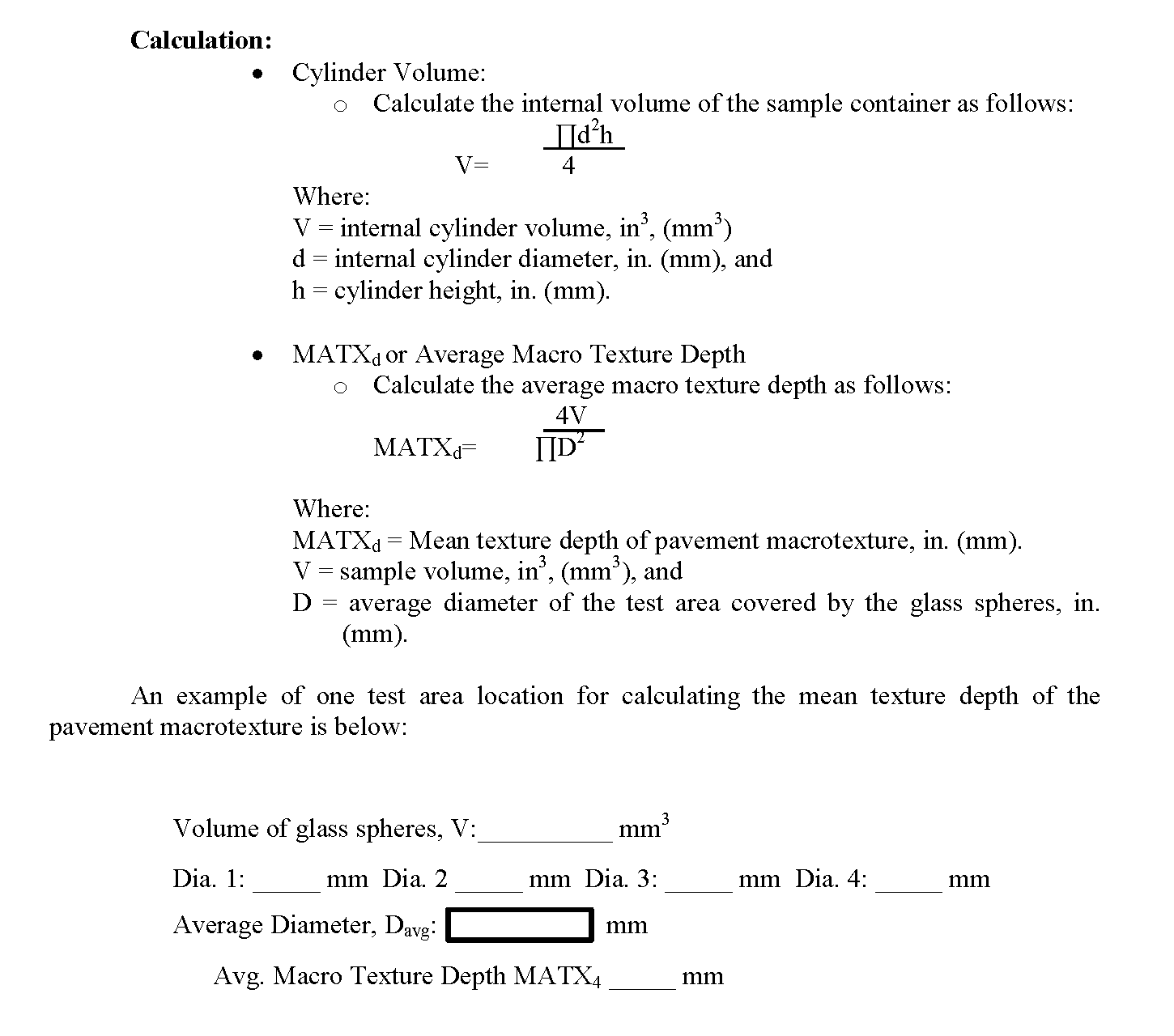
The apparatus needed to perform ASTM E 965, “Test Method for Measuring Pavement Macrotexture Depth Using a Sand Volumetric Technique” is as follows:
- Container for Glass Spheres
- Sample cylinder (35mm film container)
- Ruler
- Spreading Tool (Hockey Puck)
- Surface Cleaning Brushes (Wire Brush, Soft Bristle Brush)
- Small Straightedge (small spatula)
- Portable Wind Screen
Procedure:
Begin by selecting four randomly selected test areas in each lot (same stations as strength, and thickness cores). Note: The same technician should perform all the testing.
- Inspect the test area to be measured. Test area must be a dry homogeneous area that contains no unique, localized features such as cracks or joints.
- Thoroughly clean the surface with the stiff wire brush to remove any residue and then with the soft bristle brush remove any of the residue, debris, or loosely bonded aggregate particles from the test surface.
- Position the portable wind screen around the test area.
- Fill the small sample cylinder of known volume with the glass spheres and gently tap the base of the cylinder several times on a rigid surface. Add more material to fill the cylinder to the top and level with a straightedge. If a set of laboratory scales are available, determine the mass of material in the cylinder and use this mass of material sample for each measurement.
- Pour the measured volume or weight of material onto the cleaned test surface within the area protected by the portable wind screen.
- Carefully spread the glass spheres into a circular patch with the spreading tool (hockey puck), rubber side down, filling the surface voids flush with the aggregate particle tips.
- Measure and record the diameter of the circular area covered by the glass spheres at a minimum of four equally spaced locations, such as
0°- 180°, 45° - 225°, 90° - 270°, 135° - 315°, around the circumference.
- Compute and record the average diameter of the circle.
710-7 FINAL SURFACE TESTING
The profiler must be operated by a competent operator, typically representing the Contractor, in the presence of the Engineer or his representative from the Department. The profiler will produce data, compatible with the latest version of
FHWA’s ProVAL (Profile Viewing and Analysis) software. After the Contractor has completed smoothness testing,
the Contractor will transfer the profile data from the profiler portable computer’s hard drive to a write once storage media (DVD-R or CD-R) or electronic media approved by the Engineer. Label the disk or electronic media with the Project number, Route, file number, date, and termini of the profile data. Submit the electronic data on the approved media to the Engineer immediately after testing, the Contractor will furnish the raw data to the Engineer immediately and produce a report within
10 days
after completion of the smoothness testing. The report will include electronic files compatible with ProVAL and evaluation in tabular form with each
0.1 mile
segment occupying a row. Each row should include the beginning and ending station for each section, the length of the section, the original IRI values from each wheel path, and the MRI value for each section. Each continuous run for a section will occupy a separate table and each table will have a header that includes the following:
- The project contract number
- County
- The roadway number or designation
- A lane designation
- The dates of the smoothness runs
- The beginning and ending station of the continuous run.
Summarize each table at the bottom.
The Specifications establish limits on smoothness with an International Roughness Index (IRI) expressed in inches per mile and localized roughness that cannot exceed an IRI of
125 inches/mile at the continuous short interval of
25 feet. The Contractor will be responsible for computing the IRI and MRI for each
0.1 mile section length and noting any localized roughness greater than
125 inches/mile in any continuous short interval of
25 feet that will need repair. If any section of pavement does not meet the applicable specification requirements, over
90 IRI corrective action will be required.
The method used to compute the International Roughness Index (IRI) is given in the procedure titled,
Determination of International Roughness Index Using an Inertial Profiler is located in the
Construction and Inspection of Portland Cement Concrete Pavement Manual. Copies of this procedure can be obtained from the Pavement Construction Section. The
Pavement Construction Engineer can also provide assistance in determining how to use ProVAL and interpret the IRI information.
While a
minimal amount of grinding may be required to correct a few deficiencies in the pavement surface, excessive grinding as a means to improve ride quality shall not be permitted. Therefore, it is necessary for the Engineer to require the Contractor to begin the surface testing of the concrete pavement as soon as possible. Should the Contractor be producing concrete pavement that fails to meet the rideability Specification requirements, the Engineer should advise the Contractor that extensive grinding to correct these problems will not be permitted and that the Contractor shall undertake to correct whatever methods, equipment, materials, and/or workmanship that may be required to correct the situation. The Contractor shall not be permitted to continue paving as long as he is producing out of Specification pavement. The Contractor’s paving operations shall be immediately stopped by the Engineer until the problems are corrected, and the Contractor can construct a concrete pavement that meets the rideability requirements with minimal or no grinding. The
Construction Unit shall be apprised of the need to suspend the Contractor’s operations in order to gain compliance with the rideability requirements.
The payment for surface testing is full compensation for the Contractor furnishing, maintaining, and operating the profiler and any necessary equipment. Also included in the unit price are graph paper and any other materials or supplies that are necessary to satisfactorily complete the surface testing.
710-8 PAVEMENT MARKING
The Contractor must press metal dies having beveled faces into the fresh concrete along the outside shoulder to mark the stations of the project. The Stations should be marked in accordance with the plans and
Standard Drawing No. 710.01. In addition to the station markings, the location of all shoulder drain outlets and underground utility crossings shall be marked on the pavement edge nearest the outlet. The location of the shoulder drain outlet or drainage structure containing the drainage outlet should be marked perpendicular.
710-9 THICKNESS TOLERANCES
The determination of pavement thickness for acceptance is determined by the measurement of cores tested in accordance with AASHTO T 148 as modified by the Department. The Engineer will select and locate the random locations for core samples. The Contractor shall core the selected locations in the presence of the Engineer. The Engineer shall deliver the samples to the Materials & Tests Unit, which will measure the samples and report the results.
The thickness measurements are reported to the State Roadway Construction Engineer who makes the final determination under the provisions of
Article 105-3 of the Standard Specifications as to any reduction in payment that may be necessary for deficient pavement thickness.
This article also provides the allowable tolerance for pavement thickness and the sanctions for deficient depth. Payment shall be made based on the thickness reported in accordance with
Article 710-10.
710-10 MEASUREMENT AND PAYMENT
(A) GENERAL
This article describes the method of measurement of concrete pavement. Separate measurement will be made for pavement lots, which are deficient in either thickness or compressive strength or both. This article also covers payment of Surface Testing Concrete Pavement.
(B) PAVEMENT DEFICIENT IN THICKNESS
This article covers details of the method of payment for lots deficient in the thickness of Portland Cement Concrete pavement. Pay factors are covered from
0.2” to 1.00” and if pavement is deficient by more than
1.0”.
The adjusted contract unit price is determined by the following formula, except no pay over 100% will be allowed:
Pay Factor (%) = 110 –[50X (Plan Thickness - Average Core Thickness)]
(C) CONCRETE PAVEMENT VARYING IN STRENGTH
This article covers details of the method of payment for lots deficient in compressive and flexural strength of Portland Cement Concrete pavement.
- The pay factor for pavement achieving a compressive strength in
28 days of 4500 psi or greater is 100%. The pay factor for pavement achieving compressive strengths ranging from
4500 psi to 3000 psi is calculated using the formula below.
PAY FACTOR % = 100.0 – [0.05 x (4,500 – Compressive Strength)]
(pay factor is rounded to the nearest tenth of one percent)
- The pay factor for pavement achieving a flexural strength in
28 days of 650 psi or greater is 100%. The pay factor for pavement achieving flexural strengths ranging from
650 psi to 600 psi at 28 days is calculated using the formula below.
PAY FACTOR % = 100.0 – (650 psi – PSI)
(pay factor is rounded to the nearest tenth of one percent)
(D) MULTIPLE ADJUSTMENTS IN PRICE
This article covers pavement lots found to be deficient in both thickness and strength.
ADDITIONAL RESOURCES