PRECONSTRUCTION ACTIVITY
The Resident Engineer is expected to review the erosion control plans with the inspection technician and engineering personnel who will be assigned to the project. This review should be accomplished prior to the preconstruction conference, such that any questions raised may be properly and expeditiously answered so a complete understanding of the plans is presented to the Contractor when questions arise. The Resident Engineer shall conduct this review. The
Roadside Environmental Field Operations Engineer is to be asked to participate in the Resident Engineer’s review of the plans with his project staff whenever the contract contains phased erosion control plans. If there are questions as to concept, intent, phasing, etc., the
Roadside Environment Unit in the Central Office should be consulted to obtain necessary clarification.
PRECONSTRUCTION CONFERENCE
The Division Engineer shall include the
Regional Land Quality Engineer on the list of invited attendees for preconstruction conferences for projects involving significant land disturbing activities. As a part of the conference activity, erosion control shall be discussed in depth. It is important that subcontractors that disturb land as a part of their operations also attend the preconstruction conference. Particular emphasis shall be placed on the expectations of the Department with regard to individual and corporate attitudes toward erosion control. The Contractor and subcontractors should understand at the conclusion of the erosion control discussion that the Department will demand timely implementation of each erosion control measure or activity and that failure to respond in such a manner may lead to sanctions imposed under the provisions of
Article 102-15 and/or
Article 107-12 of the Standards Specifications.
BEGINNING OF CONSTRUCTION
For each project involving land disturbing activities of one acre or more, the Resident Engineer shall notify the
Regional Land Quality Engineer when construction has begun. As a part of that notification, the Resident Engineer shall advise the
Regional Land Quality Engineer the name of the technician who will be on the project and be responsible for inspecting sediment and erosion control activities and who will be maintaining the continuously updated erosion control plans in accordance with the Department’s program delegation. The Resident Engineer shall include as a part of the transmittal to the Regional Land Quality Engineer
one set of erosion control plans for the project.
Inasmuch as it is the policy of the
Land Quality Section to contact the project personnel when visiting NCDOT projects, other than semiannual rating visits, it is important that the person identified to the Regional Land Quality
Engineer be consistently on the project. Should personnel requirements necessitate a change of assignment, the Regional Land Quality
Engineer shall be notified. It is important that the technician selected to represent the Engineer be a person who will be on the project the majority of the time; be a person who champions timely, proper and effective erosion control techniques; and be a person who, most importantly, will portray a positive image to the Land Quality staff.
MONTHLY CONSTRUCTION CONFERENCES
For contract construction projects, recurring monthly conferences have long been the Department’s standard practice. The use of recurring dates, such as the
3rd Tuesday, allows all participants to plan their schedules. Such a practice shall be established for each project involving significant land disturbing activities, and the
Regional Land Quality Engineer should be notified of the recurring date, time, and location of the construction conference. Whether or not the Regional Land Quality staff choose to attend, erosion control shall be discussed and documented at each conference. It is expected that the Contractor’s future grading activities be closely coordinated with needed erosion and sediment control measures, such that the needed devices are in-place before the areas are disturbed and sediment loss risks have increased.
DURING CONSTRUCTION
During construction of the project, the Resident Engineer shall take the necessary measures to ensure that the project is constructed and maintained in accordance with the erosion control plans. Any modifications to the erosion control plans necessary to meet field conditions shall be clearly indicated on the set of erosion control plans maintained on the project. In order to ensure that all measures are installed and maintained as necessary, the following procedures shall be followed.
- Before any land-disturbing activity begins, the Contractor shall be specifically advised that he must install all the required perimeter controls and/or other appropriate measures must be installed before beginning grubbing on the project site and creating erodible surfaces. Grubbing is not to begin until proper sediment control devices are in-place.
- Maintain a set of
as-constructed Erosion and Sediment Control Plans (E&SC) on the project, available on-site during business hours that denote the erosion and sediment control devices that have been installed on the plans with a date and initials, including dimensions and measurements. Also include any modifications to the E&SC plans with notes regarding the details of the changes.
- Note Stormwater Discharge Outlets on the plans or document discharge points with NPDES reports.
- Periodic erosion control reviews of the project site are imperative. These shall be
weekly, at a minimum, and after every significant rainfall. The Resident Engineer shall take into consideration such factors as exposed acreage and the phase of construction during this evaluation. These reviews will be conducted by the Contractor’s Level II Supervisor in conjunction with the Department’s representative.
- After each erosion control review the Contractor shall provide a deadline for corrective action.
- The Resident Engineer shall develop a follow-up process to ensure that corrective measures are implemented. Failure on the part of the Contractor to complete the items noted on any erosion control review list by the established deadline, may result in suspension of the work until all items have been completed.
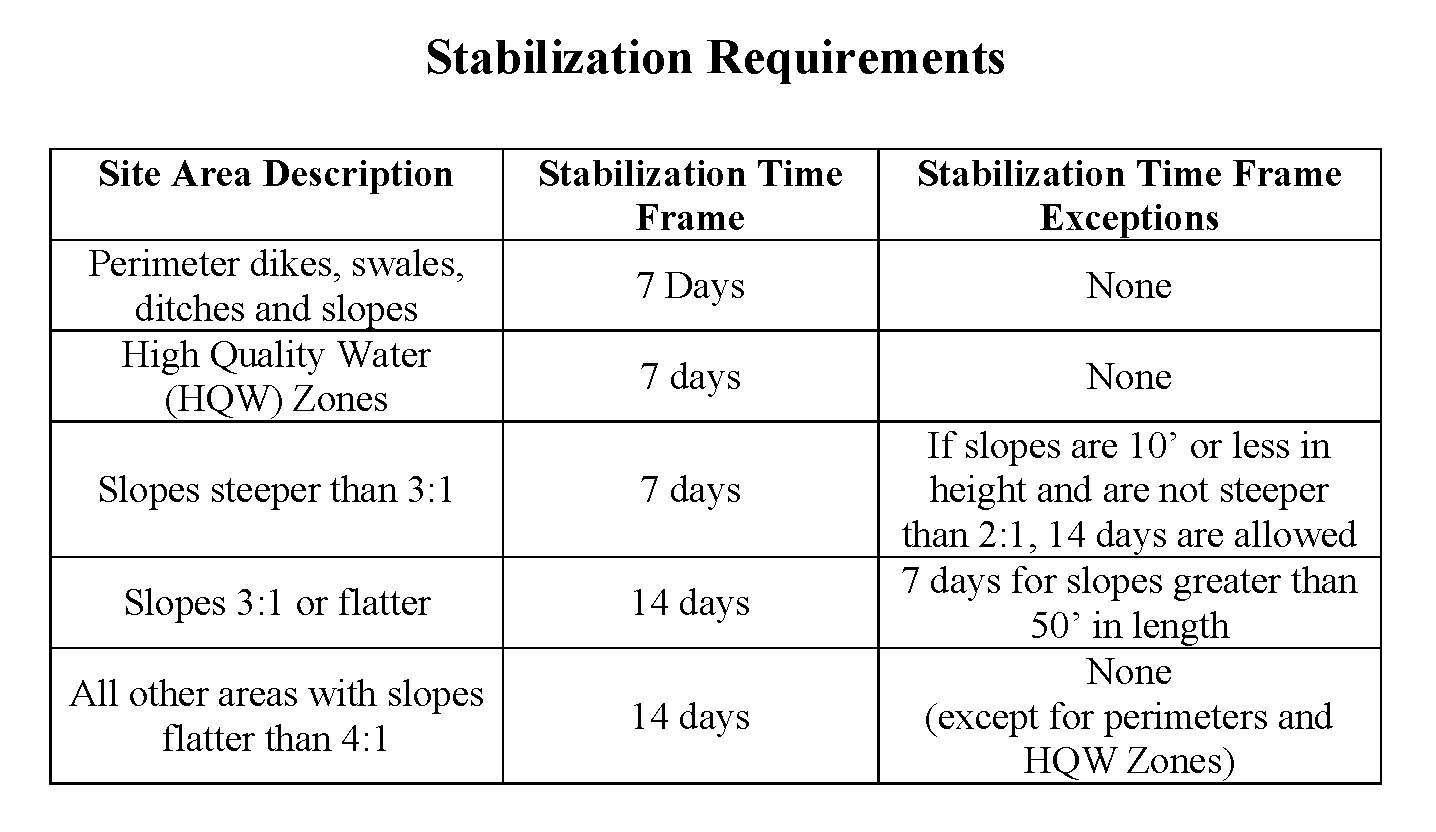
- Early establishment of permanent vegetative ground cover is an essential step in the erosion control process. This shall be accomplished by staged seeding. Any exposed areas shall be seeded within the requirements of the most current NPDES permit and project provisions.
The most current NPDES permit and project provisions establish Ground Stabilization Time frames of 7 or 14 days based on the site area. (See the Ground Stabilization Chart at the end of this section.)
- Fertilizer top dressing shall be applied to all permanent stands of grass each spring and fall for the duration of the project.
Whenever an Immediate Corrective Action (ICA) or a Notice of Violation (NOV) is issued for a project, all land disturbing activities on the project shall cease. In addition, should the Contractor no institute immediate corrective action, all work on the project may be suspended.
The Contractor shall begin corrective action within
24 hours of notification of an ICA or NOV. Should the Contractor not institute such corrective action, the Resident Engineer shall contact the Division Engineer. The Division Engineer will arrange for the use of state forces, trained in the proper installation of erosion and sediment control devices, to implement the corrective measures necessary to bring the project into compliance.
Additionally, when a NOV is received, the Resident Engineer shall write the Chief Engineer – Operations, through the Division Engineer, describing the deficiencies that caused the NOV to be issued, the actions taken to satisfy the NOV, and the measures the Resident Engineer has taken to ensure that there will be no reoccurrence.
FINAL NOTIFICATION
The Resident Engineer shall notify the Area Construction Engineer
three weeks prior to the anticipated completion of any project involving major land disturbing activities. Serving as facilitator, the Area Construction Engineer in cooperation with the Resident Engineer, Division Construction Engineer, and
Roadside Field Operations Engineer will review the project, including waste and borrow sites. The review shall address the retention of temporary measures, status of permanent measures, supplemental and repair seeding, and fertilizer top dressing. Borrow and waste sites shall be treated in the same manner as the project itself.
The review is intended to identify a plan to accept the project from the Contractor in a condition that will satisfy the Department’s sediment and erosion control responsibilities. A mature stand of vegetation on all previously disturbed areas is the ultimate objective for acceptance of the project for maintenance. This will require the cooperation of the Contractor in finishing graded slopes as soon as feasible, such that seeding and mulching can occur. This objective needs to be built into all planning on the project from the time of the preconstruction conference.
Consistent emphasis from the Resident Engineer is essential to ensure that all erosion control responsibilities are met.
PERMANENT VEGETATION ESTABLISHMENT
Contracts containing the provision
Permanent Vegetation Establishment require the contractor to establish a permanent stand of the vegetation mixture shown in the contract prior to final acceptance. The contractor must achieve an
80% vegetation density (the amount of established vegetation per given area to stabilize the soil) with no erodible areas within the project limits, as well as, in borrow and waste pits.
The provision provides that all work with the exception of permanent vegetation establishment be accepted under an Intermediate Contract Time (ICT) with final acceptance occurring once the
80% requirement has been met.
Between the time of ICT and Final Project acceptance (vegetation establishment period), the Department (Contract Administrator) will be responsible for NPDES reviews and preparing inspection records. In addition to the required NPDES reviews, the contract administrator should make routine project reviews to verify vegetation establishment. The Area Construction Engineer
should be notified as soon as it is apparent that the project has reached
80% vegetative cover. The Area Construction Engineer will review the project and determine, in conjunction with the
Roadside Environmental Unit (REU), if the requirements have been met.
The
Area Construction Engineer will accept central let projects once all work is complete and the project as achieved 80% vegetative cover. The Division Construction Engineer will
accept Division let projects once all work is complete and the project has
achieved 80% vegetative cover.
The contractor will be compensated in accordance with the provision for work performed during the vegetation establishment period necessary to facilitate vegetation establishment growth. The contractor should be notified in writing of any required action that must be taken to facilitate vegetation establishment or for erosion control.
A GOOD PHILOSOPHY
-
Treat erosion control like it is going to rain every day. (If not, you will get into trouble. It is easy to say that there is no rain in the forecast and, therefore, erosion control is not pursued as it should be).
-
Ensure the Contractor completes Form
SPPPForm30 every week with a deadline for the needs to be corrected.
-
Review the required corrective actions listed on Form SPPPForm30 and stop work when the required erosion control measures are not being installed or maintained.
-
Make an inspection during heavy rains or as soon as possible thereafter. (This will highlight potential problem areas and help you decide what needs to be done to control the erosion).
The following actions should be employed by all project personnel to prevent NOV’s (Notice of Violation):
- Modify size and location of erosion and sedimentation measures for specific site conditions and note on plan.